

HiPHI: A Large-Scale Benchmark for High-Precision Human Motion and Object-Interaction
Paper • 2608.16222 • Published
Please complete the questionnaire below and confirm your agreement with the ModalityNet Open Research License to gain access. For commercial licensing, you can contact us at info@modalitynet.com. You can also access our HiPHI Academic Paper Page on arXiv.
By submitting this form, you confirm that the information provided is accurate and agree to the dataset terms.
Log in or Sign Up to review the conditions and access this dataset content.

HiPHI is an optical motion-capture dataset for humanoid learning and whole-body motion modeling. It provides standardized BVH motion and, for human-object interaction (HOI), synchronized object trajectories and corresponding OBJ meshes.
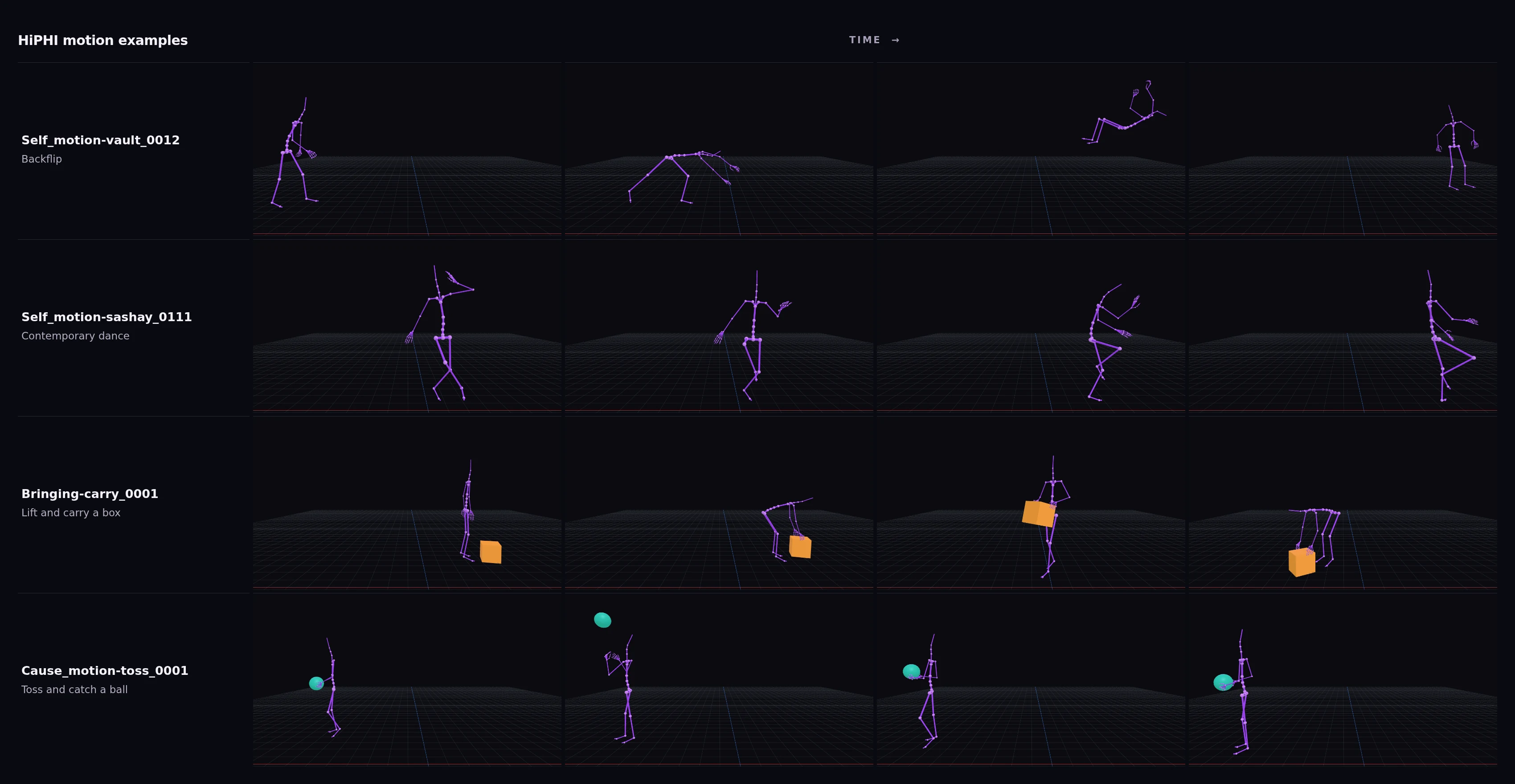
HiPHI is hosted on Hugging Face and can be downloaded using any of the methods below.
Request access and browse the repository on the dataset page:
After approval, sign in with the approved Hugging Face account before using the command-line or Python methods below.
pip install -U huggingface_hub
hf auth login
hf download noitomrobotics/HiPHI \
  --repo-type dataset \
  --local-dir ./HiPHI
from huggingface_hub import snapshot_download

snapshot_download(
    repo_id="noitomrobotics/HiPHI",
    repo_type="dataset",
    local_dir="./HiPHI",
)
hf download noitomrobotics/HiPHI \
  --repo-type dataset \
  --include "metadata/*" \
  --local-dir ./HiPHI
pip install -U huggingface_hub
hf auth login --add-to-git-credential
git lfs install
git clone https://huggingface.co/datasets/noitomrobotics/HiPHI
Run the following command from the parent directory containing the downloaded
HiPHI/ repository. All 32 archives extract into the same HiPHI/data/
package tree.
for archive in HiPHI/data/HiPHI_data_part_*.tar.zst; do
  tar --zstd -xf "$archive"
done
| Subset | Duration | Motion frames |
|---|---|---|
| HiPHI total | 617.5 h | 200.1M |
| Body-only | 371.8 h | 120.5M |
| HOI | 245.7 h | 79.6M |
HOI accounts for 39.8% of the total duration.
| Property | Value |
|---|---|
| Capture | Optical motion capture |
| Frame rate | 90 Hz |
| Human motion | Standardized 55-joint BVH |
| Performer IDs | 132 |
| Semantics | 22 Frames, 214 Frame-LU labels |
| Performer coverage | Median 23.5 performers per Frame-LU; 154 labels with at least 10 performers |
| HOI assets | Package-local object trajectories plus shared OBJ meshes |
The top 10, top 20, and top 50 Frame-LUs account for 19.2%, 30.7%, and 53.7% of the total duration.
BVH motion must be retargeted and checked for the target robot embodiment.
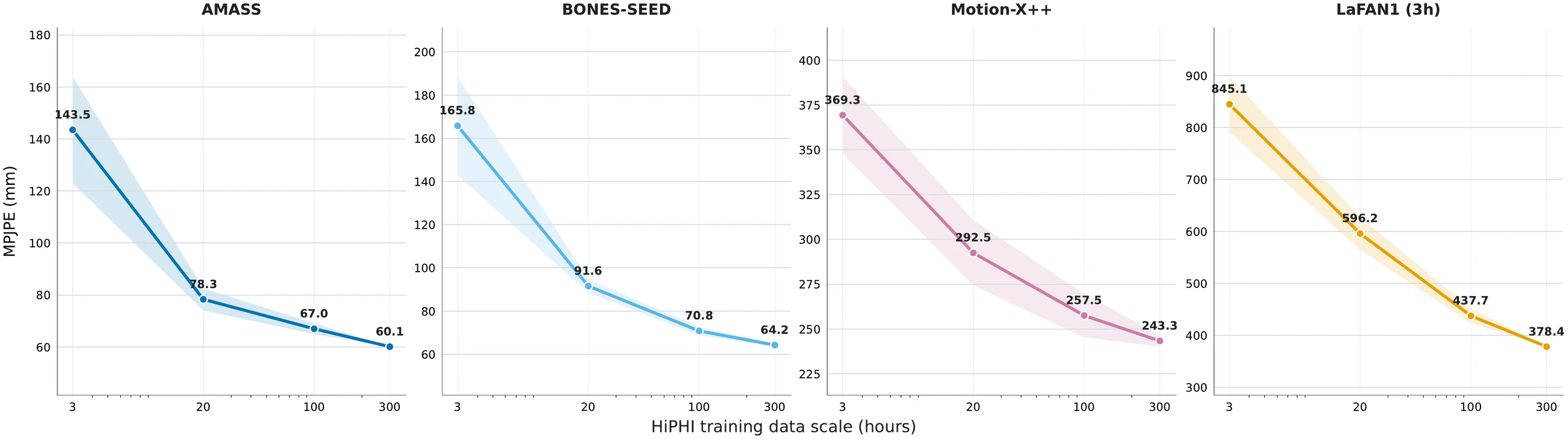
Increasing the amount of HiPHI training data from 3 to 300 hours consistently reduces cross-dataset MPJPE across the evaluated motion benchmarks.
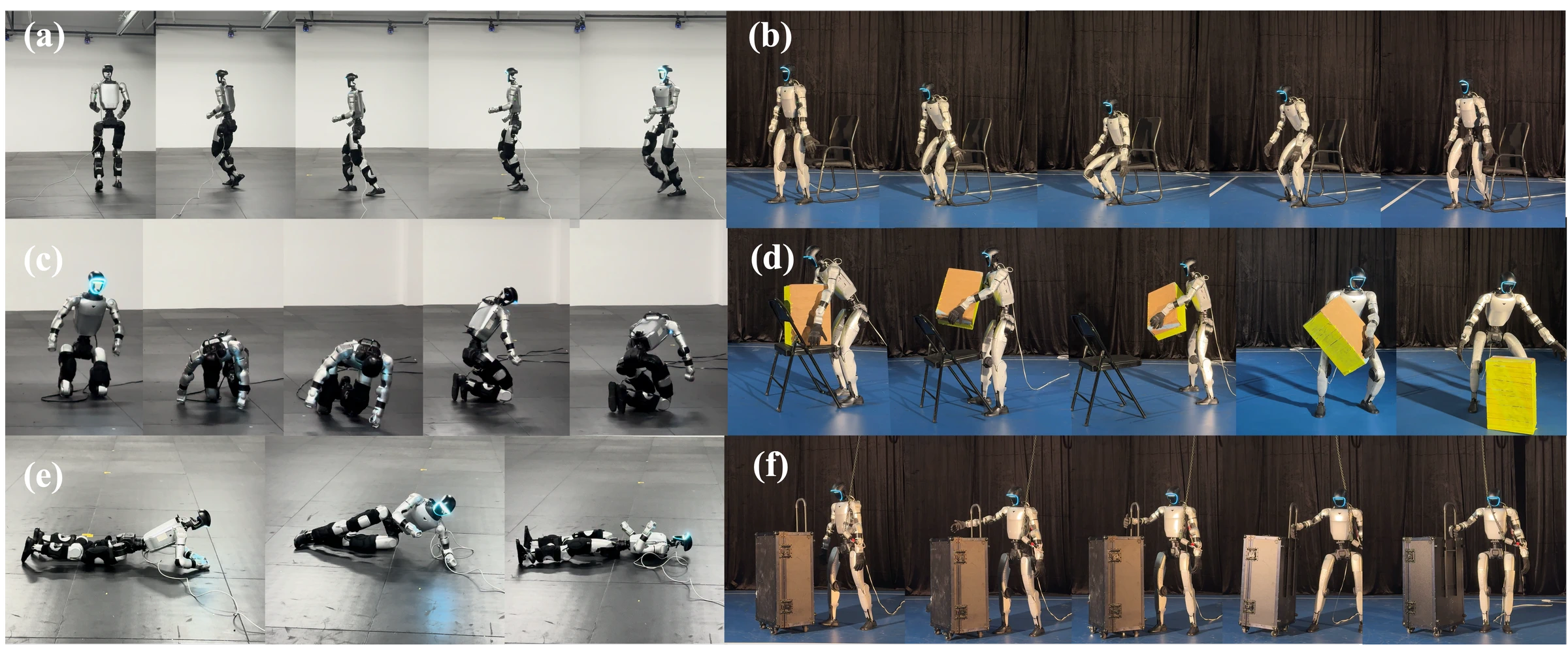
Policies trained with HiPHI are deployed on Unitree G1 for locomotion, posture changes, dynamic whole-body motion, and object-interaction behaviors.
The Hugging Face repository stores the motion package tree in 32 independent
.tar.zst archives. Each original motion and its __mirror counterpart stay
in the same archive:
HiPHI/
├── README.md
├── LICENSE.md
├── assets/
│   └── HiPHI_demo_video.mp4
├── docs/
│   ├── data_format.md
│   ├── mirroring.md
│   └── repository_layout.md
├── metadata/
│   ├── hiphi_metadata.csv
│   ├── hiphi_actor_metadata.csv
│   └── frame_lu_index.csv
├── object_meshes/
│   ├── {mesh_id}.obj
│   └── {mesh_id}__mirror.obj
└── data/
    ├── HiPHI_data_part_0001_of_0032.tar.zst
    ├── ...
    ├── HiPHI_data_part_0032_of_0032.tar.zst
    ├── archive_manifest.csv
    └── motion_to_part.csv
Archive members use the logical path
HiPHI/data/{frame}/{lu}/{motion_id}. Each motion directory contains its
motion-specific data; HOI metadata links to the shared repository-level mesh
inventory. Mirrored packages use the suffix __mirror in the same
Frame/LU directory. data/motion_to_part.csv maps each original/mirror pair to
its archive.
Original motion IDs use {frame_lu}_{xxxx}. The four-digit counter starts at
0001 independently within every Frame-LU, following the stable release
ordering. For example: Body_movement-bob_0001 and
Body_movement-bob_0001__mirror.
See docs/data_format.md, docs/mirroring.md, and docs/repository_layout.md for details.
All human motion uses the same 55-joint BVH hierarchy.
| Item | Format |
|---|---|
| Root joint | Hips |
| Articulated joints | 55 |
| End Sites | 13 |
| Coordinate system | Right-handed, Y-up |
| Linear unit | centimeters |
| Rotation unit | degrees |
| Joint channels | Xposition Yposition Zposition Zrotation Xrotation Yrotation |
| Euler order | Z-X-Y |
| Sampling rate | 90 Hz |
| Body proportions | Per-file joint offsets |
Frame count and frame time are stored in each BVH header. Duration is
Frames × Frame Time.
Release motions use the canonical approximately 90 Hz timing. Exact frame
count and frame time are stored in each BVH header. Human BVH and every object
track in a package share the same frame count and timestamps. Object-track
timestamps equal frame × Frame Time, rounded to six decimal places.
HOI requires physical interaction with a tracked object. Ground contact, locomotion, and untracked pantomime are not HOI.
Each HOI package contains:
motion_actor.bvh;metadata.json linking the motion and trajectories to the corresponding
shared OBJ mesh.frame,time_sec,px,py,pz,qx,qy,qz,qw
| Column | Type | Meaning |
|---|---|---|
| frame | int | Zero-based BVH frame index. |
| time_sec | float | Time from the first frame, in seconds. |
| px, py, pz | float | Object position in meters in the shared right-handed Y-up frame. |
| qx, qy, qz, qw | float | Object-local-to-world quaternion in XYZW order. |
Each trajectory has one row per BVH frame. The frame column synchronizes the
object trajectory with the human motion.
Object geometry uses Wavefront OBJ files. Vertices are stored in centimeters in the object's local frame, while trajectory positions use meters in the shared right-handed, Y-up world frame:
world_point_m = R(qx, qy, qz, qw) @ (0.01 * obj_vertex_cm)
                + [px, py, pz]
The repository-level object_meshes/ directory contains 40 canonical OBJ
meshes and 40 local-X-reflected __mirror variants. mesh_path in
metadata.json is a repository-root-relative path to the matching OBJ, while
mesh_id is its stable object-asset identifier. OBJ files are not duplicated
inside motion packages.
One row represents one motion sequence.
| Field | Meaning |
|---|---|
| motion_id | {frame_lu}_{xxxx} identifier and directory name, with optional __mirror suffix. |
| frame | Frame label and first directory level. |
| lu | LU label and second directory level. |
| frame_lu | Frame-LU label. |
| duration_sec | Duration from the BVH header. |
| frame_count | Number of BVH frames. |
| actor_id | Short anonymized performer identifier in A001 format. |
| text_annotation | English instruction describing the motion. |
| is_hoi | Whether the motion contains tracked-object interaction. |
| object_categories | Semicolon-separated tracked object categories; empty for body-only motion. |
| mirrored | true for a mirrored package and false for an original package. |
| Field | Meaning |
|---|---|
| actor_id | Short anonymized performer identifier in A001 format. |
| height_cm | Height in centimeters. |
| weight_kg | Weight in kilograms. |
| gender | Gender. |
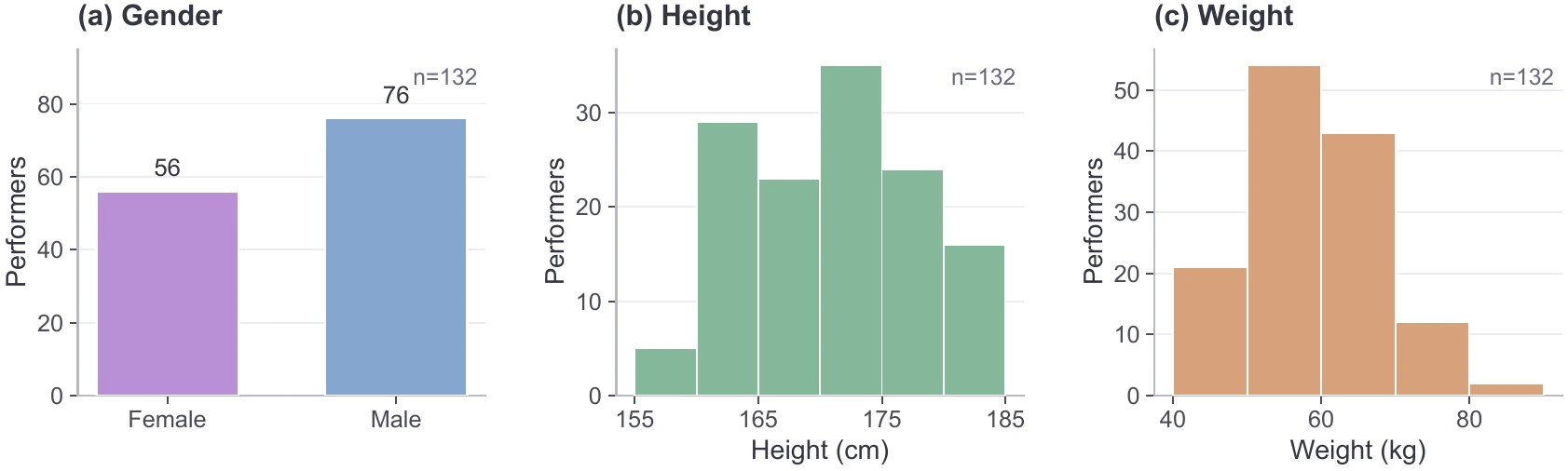
The release contains 132 anonymized performer IDs: 76 male and 56 female. Original identity and capture-session identifiers are not included.
Each package repeats its motion, Frame-LU, timing, performer, text annotation,
HOI, and mirroring fields. The annotation is stored under text_annotation.
Per-motion performer details are repeated under actor_metadata:
{
  "actor_id": "A001",
  "actor_metadata": {
    "height_cm": 165,
    "weight_kg": 55,
    "gender": "female"
  }
}
HOI object entries contain object_id, trajectory_path, mesh_id, and
mesh_path.
There is no separate interaction_type field. Interaction semantics are
represented by frame, lu, frame_lu, and text_annotation.
One row per Frame-LU with sequence count, summed duration, summed frame count, and unique performer count.
A Frame-LU pairs one Frame with one LU. The directory order is Frame first, then LU.
| Frame | Example LUs |
|---|---|
| Self_motion | walk, run, jog, stride |
| Change_posture | crawl |
| Posture | kneel, lean, squat |
| Body_movement | bend, toss, shake, clap |
| Cause_motion | push, pull, lift |
| Bringing | carry |
| Cause_to_move_in_place | rotate, shake, swing |
HiPHI contains 22 Frames and 214 Frame-LU labels.
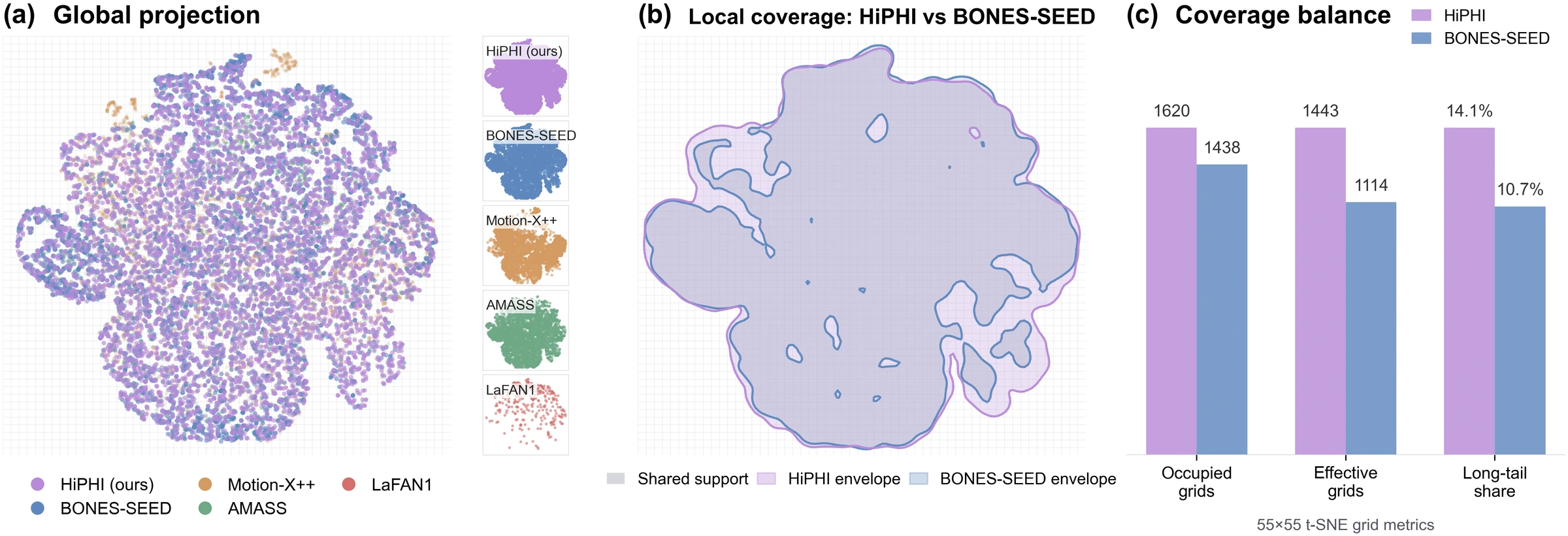
All datasets are encoded by the same unsupervised body-motion encoder and projected into one shared t-SNE space. The figure shows the global projection, the support-envelope comparison between HiPHI and BONES-SEED, and local coverage statistics on the same embedding using a 55-by-55 grid.
Every original motion has one mirrored counterpart named by appending
__mirror, such as Body_movement-bob_0001__mirror. The package and global
metadata set mirrored to true; original motions set it to false.
For HOI, the human BVH, object trajectory, and object-local mesh are mirrored
together. Mirrored OBJ vertices negate local X, face winding is reversed, and
the mirrored mesh ID appends __mirror; both mesh variants live once under
object_meshes/. See
docs/mirroring.md for the transform and validation rules.
If you use HiPHI in your research, please cite our paper:
@article{ji2026hiphi,
  title={HiPHI: A Large-Scale Benchmark for High-Precision Human Motion and Object-Interaction},
  author={Ji, Jiahao and Ma, Ji and Zhang, Runhan and Yu, Runyi and Wang, Wenjia and Chi, Weiheng and Peng, Qianqian and Yan, Weichao and Gu, Yongfei and Tian, Ye and Wu, Ting and Li, Longwei and Yuan, Chun and Dai, Ruoli and Han, Lei},
  journal={arXiv preprint arXiv:2608.16222},
  year={2026}
}